Amazon AI Interview Question
Answered Using the Machine Learning Product Lifecycle

Interviewer → Imagine you are a manager at Amazon. You need to build a feature called Complete the Look. Walk me through how you would approach this.
This question, or a version of it, now shows up in interviews for Program Managers, Product Managers, Business Analysts, Ops Managers and Strategy leads. Because every company is building AI features.
And every manager involved in those programs needs to understand how AI products are actually built.
The interviewer is not expecting you to Design a Neural Network. They are testing whether you understand the end-to-end journey of an AI feature.
From raw data to a live product serving millions of customers because if you are going to manage, consult on or make business decisions about AI programs, you need to know what happens behind the scenes.
Most candidates stumble here. They describe the user experience. They talk about the business value. They mention “Machine Learning” once and then skip to launch metrics. There is a massive gap in the middle where the actual AI work happens. The interviewer finds that gap. The interview ends poorly.
The ML Product Lifecycle fills that gap. Six stages. Each one has decisions that any manager needs to understand.
Let me walk you through the entire answer.
First, understand the feature
Before touching the lifecycle, make sure you understand what Complete the Look actually does.
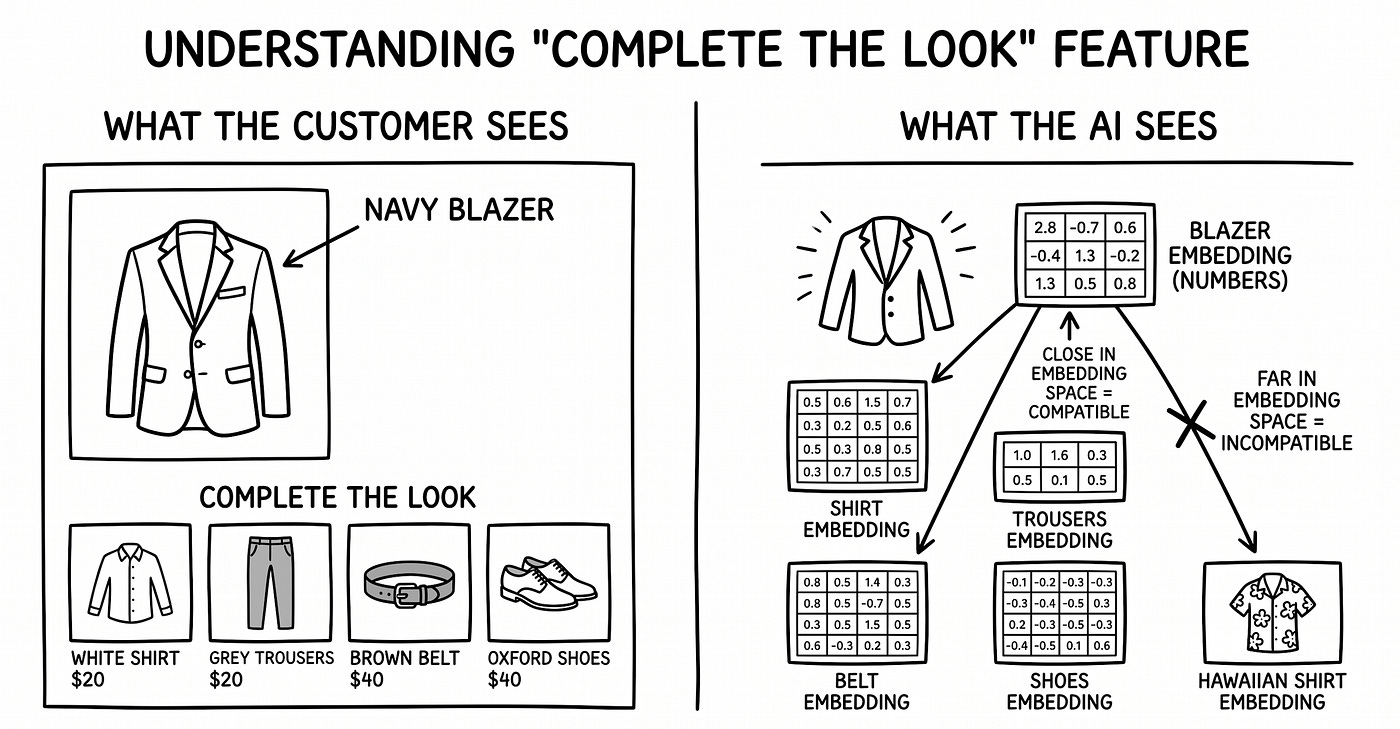
You are shopping for a navy blue blazer on Amazon. Below the product, you see a section called “Complete the Look.” It shows you a white dress shirt, grey trousers, a brown leather belt, and oxford shoes. Not random products. A coordinated outfit. Items that go together visually and stylistically.
This is not “customers also bought.” That is collaborative filtering based on purchase behaviour. Complete the Look is visual and stylistic. It understands that a navy blazer pairs with grey trousers and brown shoes, not because other customers bought them together, but because they look good together.
This distinction matters in the interview. If you confuse Complete the Look with “Frequently bought together,” the interviewer knows you do not understand the ML problem.
Complete the Look is fundamentally a visual compatibility problem. The model needs to understand what items look like, what styles are compatible and what combinations create a cohesive outfit.
Now let us build it. Stage by stage.
Stage 1: Data Collection
Every AI feature starts with data. The first question any manager working on an AI program must answer is: what data do we need and where does it come from?
For Complete the Look, you need three types of data.
Product images. High-resolution images of every fashion item in Amazon’s catalog. The AI model will learn visual features from these images. Colour, pattern, texture, silhouette, material appearance. Without high-quality images, the model cannot perceive what the product looks like.
Amazon already has millions of product images. But not all are usable. Some are low resolution. Some have cluttered backgrounds. Some show the product at unusual angles. The manager needs to understand that “we have the data” and “we have usable data” are very different statements.
Outfit data. The model needs examples of what “goes together” looks like. Where does this come from?
Fashion editorial content. Magazines and lookbooks publish curated outfits. These are expert-labeled examples. A stylist chose that shirt to go with that blazer. That is a training signal.
User behavior data. When a customer buys a blazer and trousers in the same session, that is a weak signal of compatibility. When thousands of customers buy the same combination, the signal strengthens.
Social media. Instagram outfit posts. Pinterest boards. These are publicly available examples of outfits real people put together.
Product metadata. Category (shirt, trousers, shoes). Colour. Brand. Material. Season. Gender. Price range. This structured data supplements the visual data. The model should not recommend a winter coat to complete a summer dress look.
Why this matters for any manager
If you are a program manager, you are planning the timeline and coordinating teams. Understanding the data collection phase tells you that this is not a two-week sprint. It is a multi-month data acquisition effort with dependencies on image quality, external data sources, and cross-team coordination.
If you are a consultant advising a retail client on AI, you need to tell them the truth: the model is only as good as the data. If they do not have clean product images and labeled outfit data, no amount of engineering will produce good recommendations.
If you are a business leader evaluating this initiative, you need to ask: do we have the data? What does it cost to acquire what we are missing? How long does data collection take? Budget 30–40% of the total program timeline for data work. If anyone budgets 10%, the program will slip.
Stage 2: Data Cleaning and Preprocessing
Raw data is messy. Always. The manager who assumes “we have millions of images so we are fine” has never shipped an AI product.
Image cleaning. Remove low-resolution images. Remove images with watermarks or promotional overlays. Standardise image sizes. Normalise backgrounds.
Metadata cleaning. Product categories on any e-commerce platform are inconsistent. A “blazer” might be categorised as “jacket,” “sportcoat,” or “outerwear” depending on the seller. Colours might be listed as “navy,” “dark blue,” or “midnight” for the same shade.
This matters because a model trained on inconsistent data produces inconsistent recommendations. If “navy” and “dark blue” are treated as different colors, the model might recommend a navy blazer with dark blue trousers. They are essentially the same color and would clash visually.
Why this matters for any manager
This stage is where most AI programs die quietly. Not with a dramatic failure. With slow, invisible data quality problems that degrade model performance.
The Program Manager needs to budget real time for this. It is unglamorous. Nobody gets promoted for cleaning data. But without it, everything downstream breaks.
The consultant needs to flag this risk early. “Does your data team have a cleaning and standardisation process?” If the answer is vague, the project is in trouble before it starts.
The business leader needs to understand that “We have data” is not the same as “We have clean data.” The gap between the two is weeks or months of work.
Stage 3: Data Labeling
The model needs to learn what “goes together” means. To learn this, it needs labeled examples. Pairs of items explicitly marked as compatible or incompatible.
This is the most expensive and time-consuming stage. And it is where management decisions have the biggest impact on model quality.
Positive pairs. “This blazer goes with these trousers.” Each pair teaches the model what compatibility looks like.
Negative pairs. “This formal dress does not go with these slippers.” The model needs to learn what clashes too.
Who does the labeling:
Professional stylists. Highest quality. Most expensive. Slowest.
Trained annotators with fashion guidelines. Mid-quality. Faster. Cheaper. Quality depends entirely on the guidelines you write.
Crowdsourcing. Lowest cost. Highest volume. Most noise. You need multiple people labeling each pair and majority voting to filter errors.
Why this matters for any manager
The labeling guidelines are a business decision, not a technical one. What makes two items “compatible?” Should the model match price ranges? A $30 t-shirt with a $2,000 suit? Should it respect brand aesthetics? Should seasonal compatability matter?
The manager writes these rules. Or at least approves them. The rules determine what the model learns. Wrong rules produce a technically functional model that makes recommendations no customer wants.
For the program manager, this stage has the longest lead time. Labeling tens of thousands of pairs takes weeks. It is a dependency for everything downstream. Plan around it.
For the consultant advising on this project, the labeling strategy is the single biggest controllable variable in model quality. Push the client to invest here. Skimping on labeling is the fastest way to build AI that looks good in a demo and fails in production.
Stage 4: ML Model Training
Now the data is clean, labeled, and ready. The engineering team trains the model.
For Complete the Look, the model is a visual compatibility model. It processes product images through a neural network and produces numerical representations called embeddings. Items that are stylistically compatible end up “close” together in the embedding space. Items that clash end up “far” apart.
The manager does not design the neural network. That is the ML engineer’s job. But the manager needs to understand three things.
What compute is required. Training a visual model on millions of images requires GPUs. This has cost and timeline implications.
How long training takes. Model training is iterative. Train. Evaluate. Adjust. Retrain. Each cycle takes days or weeks. Plan for multiple cycles, not one.
What success looks like. This is the critical management decision. Define the success metrics before training starts.
Compatibility accuracy: What percentage of recommended pairs are genuinely compatible?
Diversity: Does the model recommend varied items or the same style repeatedly?
Coverage: What percentage of the catalog can the model generate recommendations for?
Latency: How fast does the model return results?
If you define success after seeing the results, you will move the goalposts to match whatever the model produced. Define it upfront. Hold the team to it. This is a management discipline, not a technical one.
Stage 5: ML Model Fine-Tuning
The initial model will not be good enough. It never is. Fine-tuning adjusts the model to improve performance where it is weak.
Common issues:
Color sensitivity. The model might recommend navy with black because they are visually similar in embedding space. But navy and black together is a fashion mistake. The model needs to distinguish between “visually similar” and “stylistically compatible.”
Category confusion. The model might recommend two pairs of shoes to complete a look. It needs to understand that a complete outfit needs one item from each category. One top. One bottom. One pair of shoes. Not three tops.
Price mismatches. A technically compatible recommendation is useless if it pairs a $20 t-shirt with $500 trousers.
Why this matters for any manager
The fine-tuning stage is where timeline pressure collides with quality ambition.
The jump from 70% to 85% accuracy might take two weeks. From 85% to 90% might take six weeks. From 90% to 95% might take three months.
For the Program Manager, this is the stage where stakeholders start asking “Why is this taking so long?” The answer is diminishing returns. Each percentage point of improvement costs more time than the last. The Program Manager needs to set these expectations early. Not when the team misses a deadline before the deadline is set.
For the Consultant, this is where you add the most value. Helping the client understand that AI quality is a spectrum, not a binary. And that the business case determines where on the spectrum they should aim.
Stage 6: ML Model Deployed Into Production
The model is trained, fine-tuned and meets the success criteria. Now it goes live.
This is where most Non-technical Managers think the job is done. For AI Programs, this is where a new phase begins.
Serving infrastructure. The model needs to generate recommendations in real-time. A customer looks at a blazer. The Complete the Look section needs to load in under 200 milliseconds. Any slower and the customer has scrolled past.
A/B testing. Before rolling out to all customers, run the feature on 10% of traffic. Measure engagement, click-through rate, add-to-cart rate and revenue per session. Compare against the control group. The manager defines the success metrics for the test. Not just “Did people click?” but “Did people buy?”
Monitoring. Once deployed, model performance must be tracked continuously. Fashion trends change. New products are added daily. A model trained on last season’s data will produce outdated recommendations this season. This is called model drift. It is not a bug. It is a certainty. The only question is whether anyone notices before customers do.
Retraining cadence. The manager defines how often the model gets retrained. Monthly? Quarterly? Triggered by performance drop? This is an ongoing operational commitment, not a one-time project decision.
Feedback loops. Which recommendations did customers click? Which did they buy? Which did they ignore? This behavioural data feeds back into the training pipeline. The model improves over time because it learns from real customer behaviour.
Why this matters for any manager
The deployment phase is where AI programs differ most from traditional software. In traditional software, you ship and maintain. In AI, you ship and continuously improve. The model is a living system. It degrades if you ignore it.
The Program Manager needs to plan for post-launch operations. Monitoring dashboards. Retraining pipelines. Incident response for when the model starts producing bad recommendations. This is not a project. It is a product that needs ongoing investment.
The business leader needs to budget for ongoing model operations. The launch cost is the beginning, not the end. Compute for retraining. Human evaluators for quality checks. Engineering time for monitoring and improvements. If the budget assumes “build once, run forever,” the feature will degrade within months.
The framework applied to your interview
Here is how to use this in any manager-level interview. Not just product management but any role where you might work on, manage or advise on AI programs.
Step 1: Clarify the feature. Show you understand what the AI is actually doing. Not the UI. The model.
Step 2: Walk through all six stages in order. Data Collection. Data Cleaning. Data Labeling. Model Training. Fine-Tuning. Deployment.
Step 3: At each stage, describe the key decision a manager makes. Not the engineering work. The management decision. What data to prioritise. How clean is clean enough. Who labels and by what rules. What success looks like. When to stop fine-tuning. How to test and monitor in production.
Step 4: Show you understand that deployment is not the end. Monitoring, retraining and feedback loops are ongoing. The AI feature is a living system, not a shipped feature.
This structure works for any AI feature question. Swap Complete the Look for “Build a fraud detection system” or “Design AI-powered demand forecasting” or “Create a personalized email recommendation engine.” The six stages are the same. The management decisions at each stage are the same.
The one thing to remember
The ML Product Lifecycle has six stages. Data Collection. Data Cleaning. Data Labelling. Model Training. Fine-Tuning. Deployment.
You do not need to build the model. You need to understand the decisions at every stage that determine whether the model succeeds or fails.
What data to collect. How clean is clean enough. Who labels and by what rules. What success looks like before training starts. When to stop fine-tuning. How to monitor after launch.
These decisions are management decisions. Not engineering decisions. The candidates who walk through all six stages with specific, thoughtful decisions at each one are the candidates who get offers. Regardless of whether the role is PM, Program Manager, Consultant or Business/Strategy leader.
If you like this article, you will absolutely love our AI Program Management Course ( having real AI PM Interview Questions from Google, OpenAI, Anthropic, Amazon etc) — ( 32+ Videos ) & ( Extra 25+ Real Case studies as well )
About Author
Priyanka Dalmia! I help Business professionals, Consultants, Program Managers to become AI Native using First Principles Thinking.